01A story on a merry-go-round
Stand at the centre of a spinning merry-go-round and roll a ball to a friend at the edge. The ball misses — it swerves off sideways, as though something shoved it mid-flight. Your friend saw it too. You'll both swear the path was curved.
Someone watching from a balcony above laughs. From up there the ball rolled in a perfectly straight line, exactly as Newton promises for a free object. It was your friend who moved — the ride carried them out from under the ball's path while it flew.
Both stories are honest reports. But because you and your friend share the ride, everything on it agrees the world is standing still — so the missing motion of the observer gets rebooked, in your account of events, as a mysterious sideways push on the ball. That rebooked push has a name: the Coriolis effect. It is not a force anything exerts. It is the signature your own turning leaves on everything you watch.
Now the key move: Earth is the merry-go-round. It turns once a day, slowly enough that you never feel it — but a shell in flight for a minute, wind blowing for days, or a pendulum swinging for hours accumulates the discrepancy, and we ground-riders see their paths bend.
02The live experiment: one flight, two truths
Try this, in order: ① Press Launch and watch both panels — they show the same puck at the same moments. Straight on the left (space's view), curved on the right (the rider's view). ② Drag on the left panel to slingshot the puck any way you like; drag on the right panel to aim as the rider — the curve mocks your aim either way. ③ Turn the rotation to zero: the two views become identical, and the "force" evaporates. ④ Reverse the spin: the deflection flips from rightward to leftward — exactly the difference between the Northern and Southern Hemispheres. ⑤ Turn on the force arrows in the right view and watch the Coriolis arrow always point at 90° to the velocity — it can only turn the path, never speed it up.
Turntable · same trajectory, inertial frame vs rotating frame, integrated both ways
The right-hand path is computed twice, independently: once by rotating the straight-line trajectory into the rider's coordinates, and once by integrating the rotating-frame equations with their Coriolis and centrifugal terms (RK4). The cross-check chip shows the distance between the two answers — it stays near machine precision, which is the whole point: the "fictitious forces" are exactly the bookkeeping required to make the rider's wrong assumption ("I am not moving") give the right trajectory.
03From a curved puck to a hurricane
Now let the deflection build something. A patch of warm ocean heats the air above it; the air rises and pressure drops — a "low." Surrounding air is pulled inward from all directions to fill it. Without rotation that would be a quick, boring in-rush, over in hours.
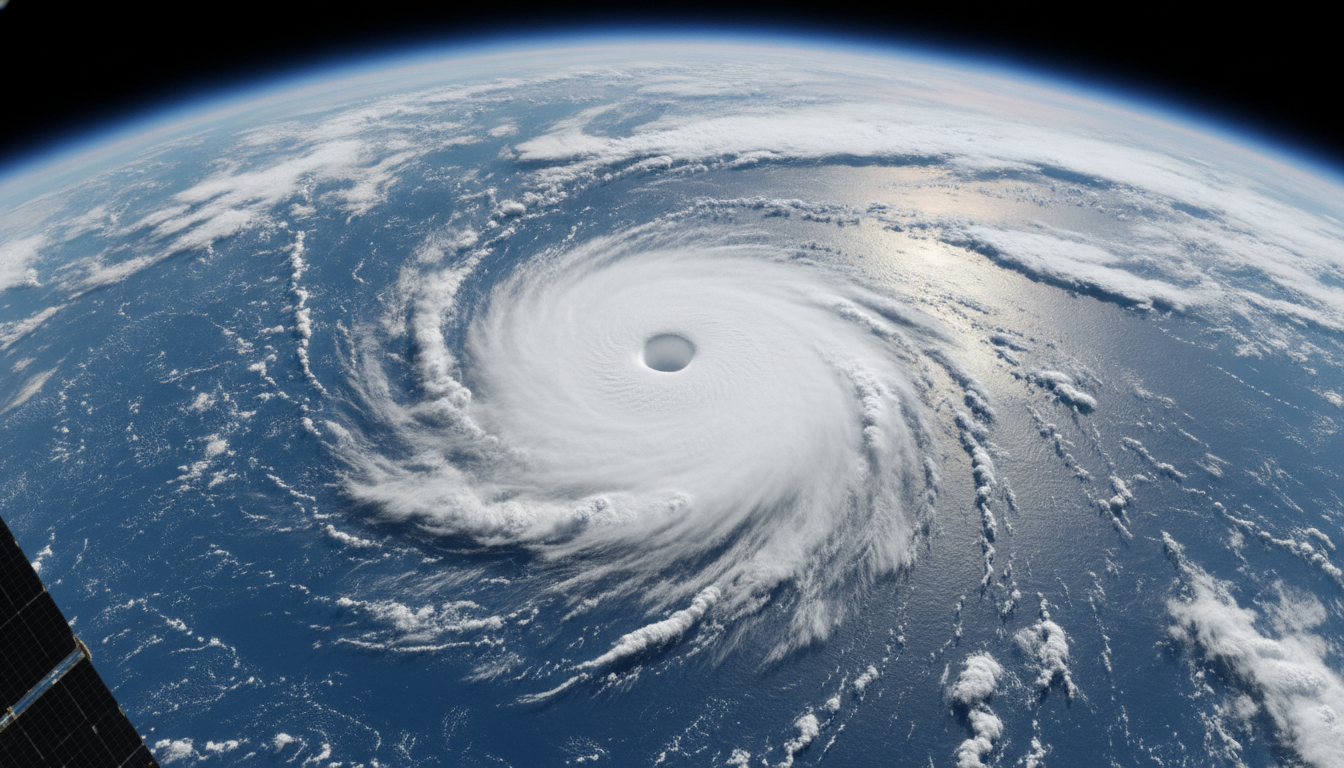
But every one of those inbound streams is deflected — in the Northern Hemisphere, to its right. Air from the north veers west, air from the south veers east, air from the east veers north… each stream misses the centre on the same side. The inflow organizes itself into a counterclockwise spiral, and the harder the pressure pulls, the faster the spiral wraps: a heat engine with a built-in steering wheel. That is why every Northern-Hemisphere hurricane spins counterclockwise, every Southern one clockwise — and why none form on the equator itself, where the deflection vanishes.
Cyclone builder · air parcels: pressure pull + Coriolis deflection + friction
Each mote is an air parcel obeying inward pressure force − f ẑ×v − friction, nothing more. Slide f to zero: the parcels fall straight into the low and the storm never forms — the equator's alibi. Flip the hemisphere and the spiral unwinds and rewinds the other way. Parcels reaching the calm centre "rise and vent" (respawn outside): the eye of the storm.
The wrong picture — and where it breaks
Wrong idea #1: "The Coriolis force pushes things sideways." Nothing pushes. The left panel of the turntable is the entire refutation: in space's honest view the puck goes dead straight, always. The curve exists only in the rider's account — it appears exactly when you adopt the spinning viewpoint and vanishes when you leave it. (Contrast a real push, like magnetism from the last exhibit: no change of viewpoint can make that go away.) Physicists still call it a "force" because inside the rotating frame it behaves like one, bookkeeping-perfect — the cross-check chip is the proof.
Wrong idea #2: "It determines which way my sink drains." The effect is real at every scale but pathetically weak at small ones. Earth turns once per day — during the two seconds your sink takes to swallow, the planet rotates 0.008°, deflecting the water by a few micrometres. The leftover swirl from filling, a nudge of the plug, an off-centre drain — each is thousands of times stronger. A hurricane is different because the air travels for days: the same feeble nudge, compounding over 100,000 seconds across 1,000 kilometres, wins. The Coriolis effect doesn't care how big you are; it cares how long you fly.
Wrong idea #3: "Hurricanes spin because the Earth drags the air around." Nearly backwards — Earth's surface drags the air with it (that's friction, and it weakens storms). The spin comes from the geometry above: converging flows all deflected to the same side. The cyclone sim contains no "drag it around" term at all — pull, deflect, done — and the spiral appears anyway.
04The law behind it
What a rotating observer must add to Newton
Real acceleration, plus the Coriolis term (velocity-dependent, always at 90° to the motion), plus the centrifugal term (position-dependent, always outward). Purely kinematic — derived by differentiating coordinates twice in a turning frame, no new physics anywhere.
On Earth at latitude φ, the horizontal deflection strength is set by
Tiny — but it multiplies by time. A 100 km/h wind at mid-latitudes: ≈ 0.003 m/s², a thousandth of gravity. Over 3 days of travel that reshapes a continent's weather.
Sense of the deflection: to the right of motion in the Northern Hemisphere (Ω·sin φ > 0), to the left in the Southern — hence counterclockwise northern cyclones, clockwise southern ones, and zero organizing power at the equator (sin 0 = 0).
The same absent force trims artillery tables (a 30 km shell drifts ~60 m), steers ocean gyres and the trade winds, twists Foucault's pendulum around its pit over a day — the 1851 experiment that made Earth's rotation visible in a basement — and must be corrected for in every long-range flight plan and missile guidance system on the planet. Not bad for a force that doesn't exist.
About this exhibit: the turntable integrates the free puck exactly and the rotating-frame ODE (Coriolis + centrifugal) with RK4, displaying the live difference between the two as a consistency proof. The cyclone parcels obey inward pressure force − f ẑ×v − friction, integrated per frame. Hero image is an AI-generated illustration (Nano Banana via the KIE API). Single offline file — view source for the numerics.