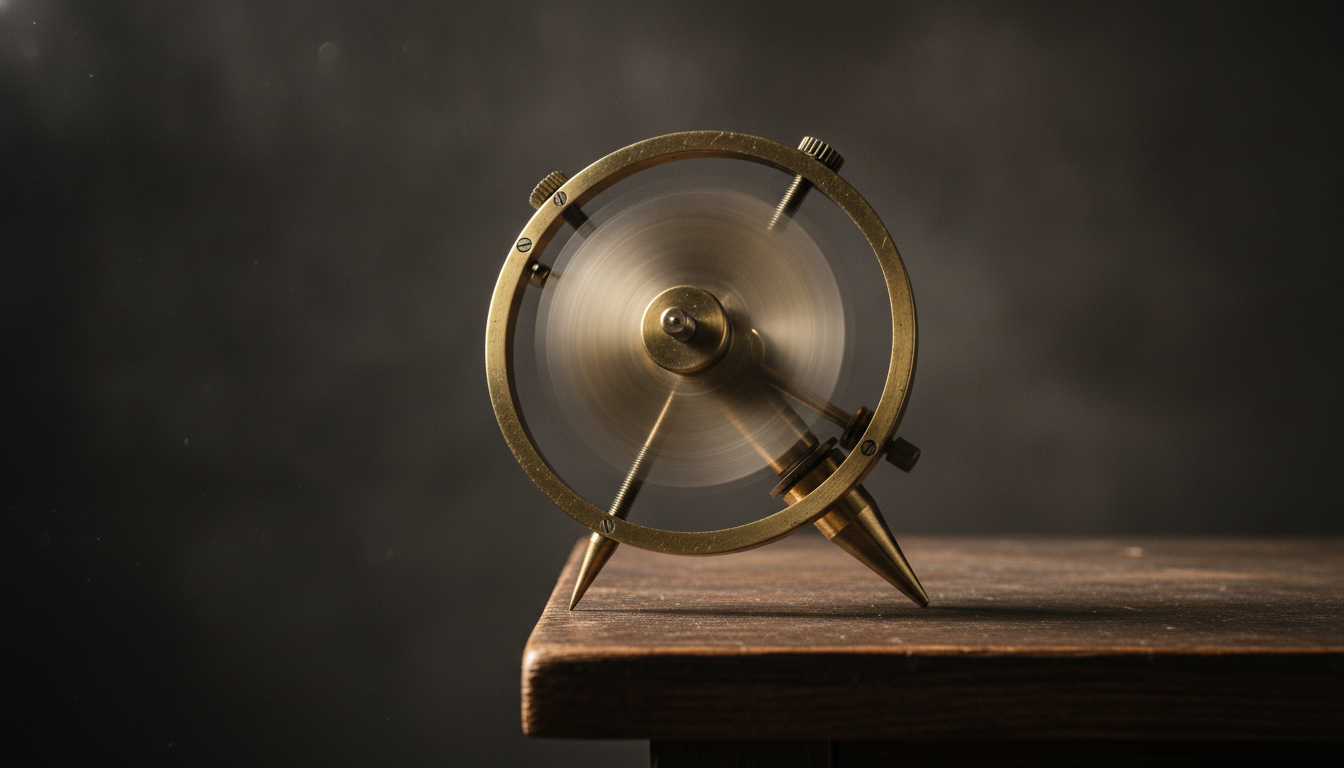
01Start with what should happen
Take the wheel without spinning it and rest one end of its axle on the post. You know exactly what happens: it pivots and falls. Gravity pulls the heavy wheel down, the post acts as a hinge, over it goes. No mystery.
Now spin the wheel fast and repeat. Gravity hasn't changed. The wheel weighs the same, the post pushes up in the same place. Yet the axle stays almost level and begins a slow, stately circle around the post — a motion called precession. Nothing visible is holding it up.
The resolution is one of the most satisfying in classical physics, and it doesn't need any new forces. It needs one idea taken seriously: rotation is a quantity with a direction, and forces can only change it — not erase it.
02Watch the real thing
03The live experiment
This is not an animation of what a gyroscope "should" do. The computer is integrating the actual equations of motion of a heavy spinning top — the same ones physics students meet in advanced mechanics — sixty times a second. Anything you see here, including the little wobbles, is what the equations themselves do.
Try this, in order: ① Press Release with fast spin — watch the calm circling. ② Try the Slow spin preset — the axle dips and bobs as it circles (that scalloped wobble is nutation, and it's real). ③ Try No spin — it simply falls, like your intuition said. ④ Turn on slow motion and watch the tip trail draw its scallops. Drag the view to orbit the camera.
Heavy spinning top · live integration of the equations of motion
The rotor is a 150 g, 7 cm disc whose centre sits 4.5 cm from the pivot. The integrator is fourth-order Runge–Kutta on the Euler-angle equations of a symmetric top; energy drift is displayed as an honesty check — if the number stays near zero, the wobbles are physics, not numerical noise. The predicted chip uses the textbook fast-top formula Ω = Mgℓ/I₃ω; the measured chip times the simulated axle. They should agree to a few percent at high spin.
04How to think about it
Here is the honest one-sentence answer: the wheel is falling — but "falling", for a spinning object, means something different than you think.
A spinning wheel carries angular momentum: a quantity L that points along the axle (curl your right hand's fingers with the spin; your thumb gives the direction). The faster the spin and the heavier the rim, the longer this arrow. The deep rule — as fundamental as "force changes velocity" — is that torque changes angular momentum: gravity's twist doesn't move the wheel downward, it moves the arrow.
Now look at the geometry, because everything lives there. Gravity pulls down on the wheel's centre, which hangs off the side of the post. That makes a twist — a torque — whose own direction (same right-hand trick) is horizontal, at right angles to the axle. So each instant, the arrow L gets a tiny nudge sideways, never lengthwise. An arrow that is only ever nudged perpendicular to itself doesn't grow or shrink or tip over — it swings around, like the tip of a clock hand. The axle follows the arrow. That slow swing is the precession you see.
An everyday analogy: a fast cyclist and a standing one. Shove the standing cyclist and they topple. Shove the fast one and the bike swerves — the push became a change of direction, because there was already a lot of motion for the push to act on. Gravity "shoves" the spinning wheel, and the wheel's response is a swerve of its axis. The bigger the spin, the bigger the existing arrow, the smaller the swerve each second — which is why faster spin means slower precession. Verify that in the simulation: halve the spin and the measured precession period halves too.
The wrong picture — and where it breaks
Wrong idea #1: "Spinning creates an upward force that cancels gravity." It doesn't, and you can see it in the experiment. What holds the wheel up is the ordinary support force of the post — same as for a non-spinning wheel resting on it. If spin made an anti-gravity force, a gyroscope on a scale would weigh less while spinning. It doesn't (this has been measured to exquisite precision). The spin never fights the pull; it redirects the fall. Set the spin slider to zero mid-flight — the "force" doesn't fade out gradually, the redirect just stops and it drops like any dead weight.
Wrong idea #2: "Faster spin should whip it around faster." The simulation shows the opposite: crank the spin from 1500 to 6000 rpm and the circling slows down by 4×. Precession isn't powered by the spin — it's gravity's fixed budget of twist being spread over a bigger angular momentum. Big arrow, same nudge: slower swing.
Wrong idea #3: "The axle stays perfectly level." Look closely at the tip trail (slow spin preset, slow motion): the axle actually does start to fall the instant you release it — then the falling motion itself gets redirected, overshoots, and swings back up. The result is a scalloped bob called nutation. Real gyroscopes nutate; friction usually damps it within a second, which is why textbooks get away with drawing a flat circle. There is a lovely bookkeeping reason the dip must happen: the slow circling itself carries a little angular momentum about the vertical axis, and the only place to get it from is gravity tipping the wheel slightly downward first. The equations remember this; the cartoon doesn't.
05The law behind it
Torque steers angular momentum
Newton's second law, translated to rotation: torque is the rate of change of angular momentum.
For a wheel of mass M spinning at ω with moment of inertia I3, its centre a distance ℓ from the pivot, gravity supplies torque τ = Mgℓ sin θ perpendicular to the axle while the spin momentum along the axle is L = I3ω . A vector of fixed length being turned at right angles rotates at rate τ/L, and the tilt angle θ cancels out of the ratio:
Spin ω is downstairs: spin faster, precess slower — the counterintuitive scaling you just verified.
Every claim on this page is contained in that first equation. The simulation integrates its full form (the Euler–Lagrange equations of a heavy symmetric top), which is why nutation appears without being programmed in: the flat-circle formula above is only the time-average, and the equations know the difference.
The same mechanism steers your world quietly: it stabilizes bicycle wheels and thrown footballs, holds the spin axes of satellites and ship gyrocompasses, and — driven by the Moon's gravity torquing the spinning Earth — swings our planet's own axis in a 26,000-year precession that slowly reassigns the North Star.
About this exhibit: the simulation integrates the heavy-symmetric-top equations (RK4 on the Euler angles, conserved momenta pψ, pφ; energy drift shown live). Hero image and video are AI-generated illustrations (Nano Banana / Veo 3.1 via the KIE API) and depict the phenomenon qualitatively. Built as a single offline file — view source to see the equations.