01The puzzle
Add a second speaker and every spot in the room should get louder. That's how it works with two heaters, two lamps, two of almost anything. But sound is not a stuff that piles up — it is a motion, a rhythmic push-and-pull of the air. And motions can disagree.
Picture two people holding one long rope, each flicking waves toward the other. Where the waves meet, the rope can't do two things at once — it does the sum. If one wave says "up two centimetres" and the other says "up two centimetres," the rope goes up four. But if one says "up two" and the other says "down two" — the rope, at that spot, at that instant, does nothing at all. Both waves are fully there. Their instructions cancel.
That single idea — displacements add, and can add to zero — is called superposition, and it is the entire mechanism of this exhibit. Watch it happen first in one dimension:
Two pulses on one string · 1-D wave equation, two components integrated separately
The faint blue and amber curves are the two travelling pulses, each obeying the wave equation on its own; the bright curve is their sum — the only thing a real string would show you. Flip the right pulse downward and watch the crossing moment: the string goes flat… then both pulses walk out the other side intact. (Where was the wave while the string was flat? In its velocity — the string is flat but moving. Freeze-frame thinking fails; waves live in motion.)
02Now in two dimensions: the ripple tank
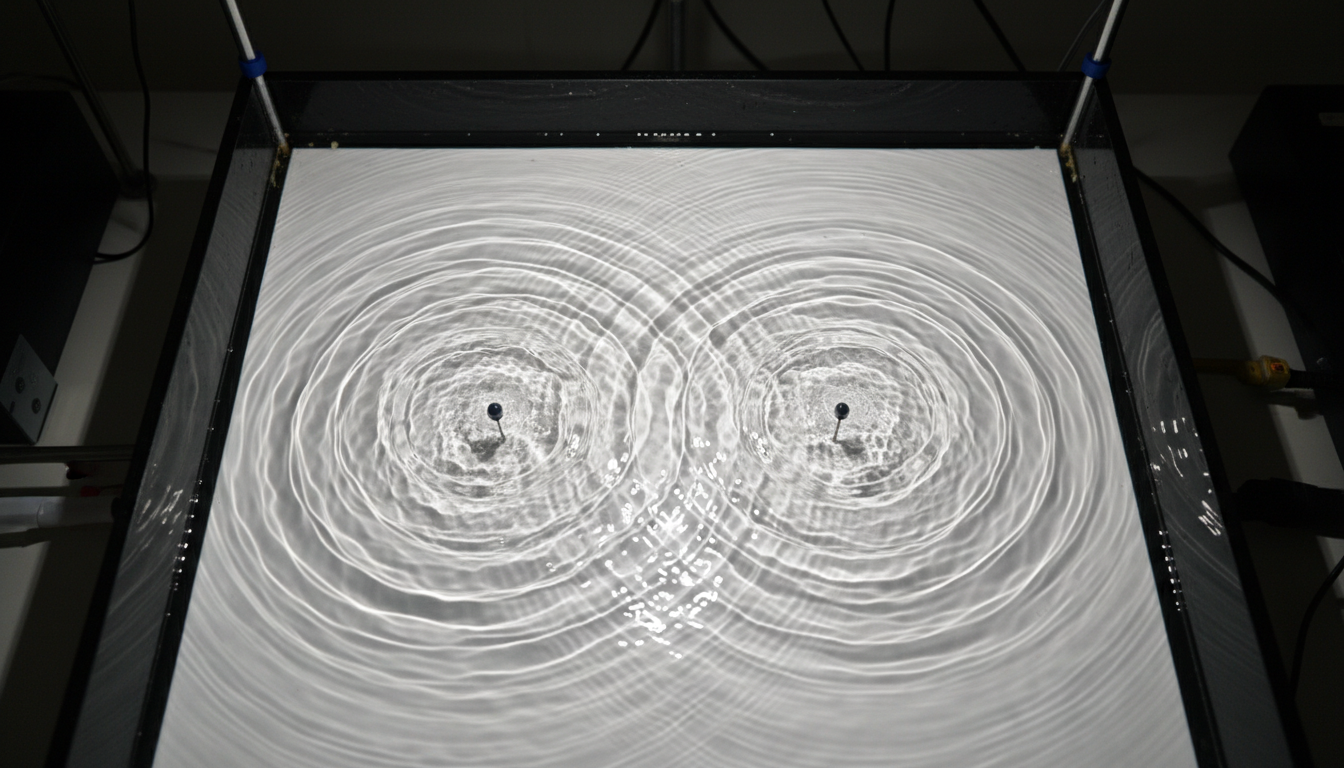
Put two rhythmic sources in a tank of water. Each sends out expanding circles. At any point in the tank, the two arriving waves have travelled different distances — so they arrive with different timing. If the path difference is a whole number of wavelengths, crest meets crest: double height. If it's off by half a wavelength, crest meets trough: flat calm. Since the path difference changes smoothly as you move around the tank, the calm spots line up into elegant curved lanes — nodal lines — frozen in place while everything between them churns.
Try this, in order: ① Watch the calm lanes form, then switch the view to brightness = wave energy — the lanes are permanent. ② Turn on predicted nodal lines: the white curves are drawn from pure geometry (path difference = half-wavelengths) before the waves get there — the simulation then paints its dark lanes exactly on top of them. ③ Raise the frequency: shorter wavelength, lanes pack tighter. ④ Widen the source spacing: more lanes. ⑤ Click anywhere to drop a probe and watch the water bob — or not — at that spot. ⑥ Switch one source off and every lane vanishes: one source alone has no silence.
Ripple tank · finite-difference solution of the 2-D wave equation, live
Every pixel is a water-surface cell obeying ü = c²∇²u (leapfrog integration, Courant number 0.45, absorbing sponge at the edges). Nothing about interference is programmed in — the dark lanes emerge from 47,000 cells each minding its own local physics. The overlay curves are hyperbolas computed independently from the path-difference rule; their agreement with the emergent lanes is the theory being checked against the experiment in front of you.
03Trap the wave: standing waves
Interference needs two waves — but they don't need two sources. Send a wave down a guitar string and it reflects off the fixed end and comes back through itself. Now the string hosts two identical waves travelling in opposite directions, interfering everywhere, all the time.
At most driving frequencies the reflections come back out of step and the string just shivers. But at special frequencies — where a half-wavelength fits the string a whole number of times — every reflection reinforces the last, energy accumulates, and a dramatic frozen pattern of loops appears: a standing wave. Points of permanent stillness (nodes) alternate with points of violent swing (antinodes). The pattern doesn't travel; it stands and breathes. This is resonance, and it is why a string of fixed length sings one note and its overtones — the physical basis of musical pitch.
Try this: sweep the frequency slowly and feel for the resonances (marked ♪). Between them, almost nothing; on them, the string blooms. Each successive resonance adds one more loop. Then raise the damping — the bloom shrinks, which is why real guitar notes fade.
Driven string · 1-D wave equation with reflection, damping, and a wiggled end
The left end is wiggled with a tiny fixed amplitude; the right end is clamped. Resonances live at fn = n·c/2L — the ♪ marks are computed from that formula, while the growth you see is the integrator discovering the same frequencies by itself. Give each resonance a few seconds to build: resonance is accumulation, not instant response.
The wrong picture — and where it breaks
Wrong idea #1: "The waves collide and destroy each other." Waves are not billiard balls. Rewind to the 1-D pulse experiment: send opposite pulses, and at the crossing instant the string is perfectly flat — yet a moment later both pulses stride out unharmed. They never touched each other; each one only ever told the string what to do, and for one instant their instructions summed to zero. Interference is bookkeeping, not combat.
Wrong idea #2: "The quiet lanes are where the sound energy got destroyed." Energy can't be destroyed, and the simulation shows where it went: switch the ripple tank to the energy view. The dark lanes are matched by bright lanes that are brighter than two sources' worth — four times one source's intensity, not two. Doubling the wave height quadruples the energy (energy goes as amplitude squared), so the loud lanes overshoot by exactly as much as the quiet lanes undershoot. Interference never deletes energy; it re-routes it. Noise-cancelling headphones exploit this: they don't annihilate the noise's energy at your eardrum, they arrange for it never to arrive there.
Wrong idea #3: "A standing wave is the string simply flexing in place." It looks that way, but you watched it get built: it is two travelling waves — the drive and its reflection — passing through each other forever. The nodes are simply the places where the two are permanently out of step. The math section below shows the two pictures are literally the same expression, factored two ways.
04The law behind it
Superposition — because the wave equation is linear
If u₁ and u₂ are each a valid wave, their sum is too — instructions add, point by point, instant by instant.
Two sources in step, heard at a point whose distances to them differ by Δ:
And two identical waves travelling opposite ways factor into a shape that stands still and breathes:
The left side is the travelling-waves picture; the right side is the standing-wave picture. Same physics, factored two ways: sin(kx) fixes the frozen node pattern, cos(ωt) makes it breathe.
This mechanism is everywhere waves are: it tunes every instrument (standing waves), quiets airline cabins (engineered cancellation), reads molecular structure from X-ray diffraction patterns, and — in the double-slit experiment, where single electrons paint the same striped pattern one dot at a time — it became the doorway to quantum mechanics. Learn these stripes here in water; you will meet them again at the bottom of reality.
About this exhibit: the ripple tank integrates the 2-D wave equation by finite differences (leapfrog, Courant 0.45, sponge boundaries); the string sims integrate the 1-D equation the same way. Nodal-line overlays are computed independently from path-difference geometry as a live theory-vs-simulation check. Hero image and video are AI-generated illustrations (Nano Banana / Veo 3.1 via the KIE API). Single offline file — view source for the numerics.