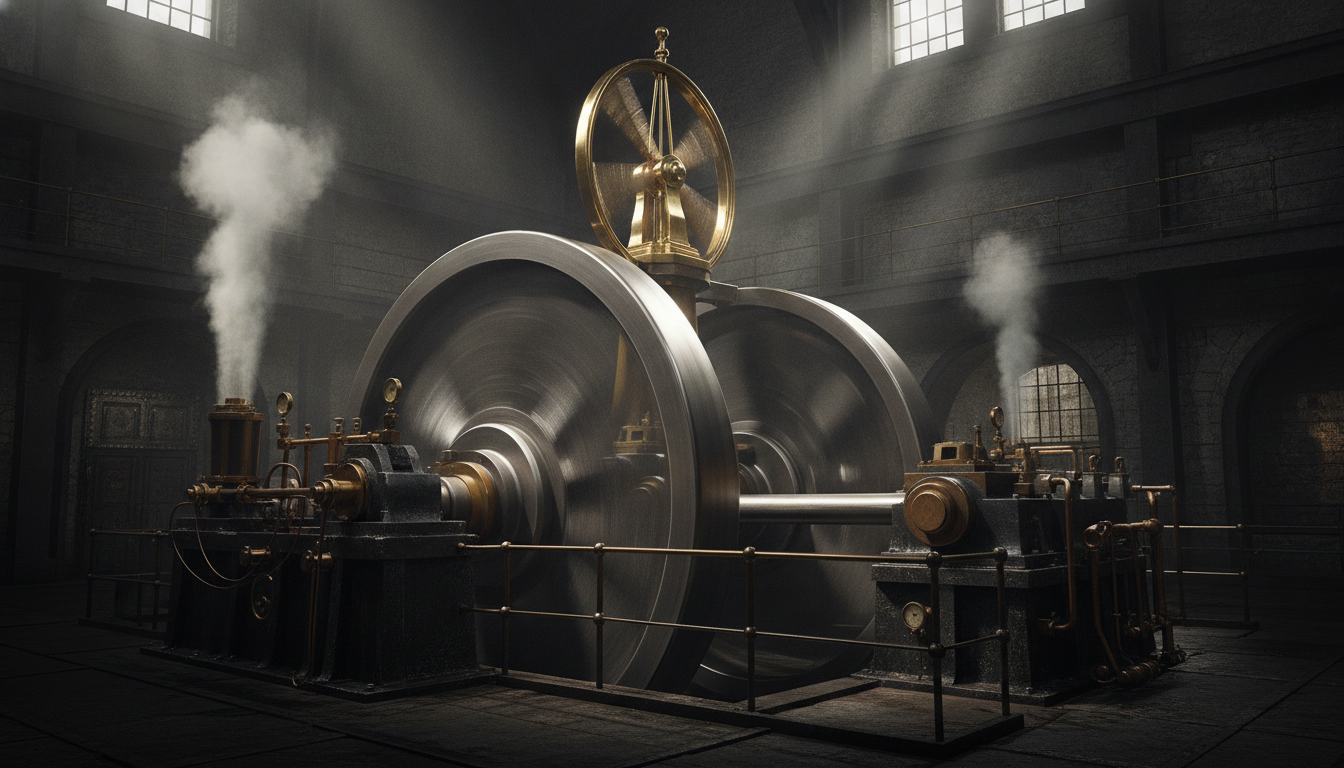
01The deepest everyday mystery
Film a pendulum and play the tape backwards: nobody can tell. Film cream stirring into coffee and play that backwards: everyone laughs instantly. But the coffee is only molecules, and each molecular bounce is as reversible as the pendulum. Where does the one-way-ness come from?
From counting. Here is the whole idea, in a card game. Shuffle a deck and deal: any particular sequence of 52 cards is exactly as improbable as any other — a sorted deck is not one bit less likely than the jumble you actually got. So why are you never dealt a sorted deck? Because "sorted" describes a handful of arrangements, while "jumbled" describes essentially all of them. You don't get jumble because jumble is favoured; you get jumble because jumble is almost the only thing there is.
Now replace 52 cards with 10²³ molecules. "All the fast molecules on the left" — hot coffee here, cool cream there — is a sorted deck: astronomically few arrangements look like that. "Everything lukewarm and tan" is the jumble: essentially all arrangements look like that. Every collision reshuffles. The system doesn't seek uniformity; it merely wanders among arrangements, and uniformity is where nearly all of them live. The count of arrangements has a name — entropy — and "entropy increases" means nothing deeper or spookier than: a shuffled system drifts toward the way most arrangements look.
Time's arrow, heat's one-way flow, and the fading of every engine's usefulness are this one sentence wearing three costumes. Watch it happen:
02The live experiment: hot meets cold
Try this, in order: ① Watch the two gases behind the wall — every particle is colored by its speed (red = fast, blue = slow). Even now, watch the speed histogram: each side starts as a single spike (all particles alike) and collisions alone melt it into the famous bell-ish curve (the Maxwell distribution) — order dissolving before the main event. ② Remove the wall. Watch the colors interleave, the two temperature curves converge, and the entropy curve climb its one-way staircase. ③ Now the profound one: press Reverse all velocities. Every microscopic law says the film must run backwards — and it does: watch the gases briefly un-mix. Then chaos amplifies the tiniest numerical dust, the rewind decays, and probability resumes command. You have just watched the resolution of Loschmidt's paradox: reversibility is legal, it's just a lottery ticket.
Two gases, one box · 340 colliding disks — temperature, entropy and the Maxwell curve, live
Every particle obeys nothing but straight-line motion and elastic collisions — Newton, run honestly (total energy is displayed as the check; it must not drift). Temperature is defined here as average kinetic energy per particle; entropy is the coarse-grained arrangement count −Σp·ln p over position cells and speed bins. Nothing in the code says "mix", "equalize", or "increase entropy". It all just… happens. That's the point.
03From counting to engines
Now the practical half of the story — why your car engine wastes most of its fuel, by law.
Energy is never used up; it is spread out. Concentrated energy (hot gas in a cylinder, charge in a battery) can push things; spread-out energy (lukewarm everything) cannot. An engine is a device that intercepts energy while it spreads — a waterwheel in the flow from hot to cold — and diverts part of the flow into motion.
Why only part? Entropy bookkeeping. Taking heat Qh out of the hot boiler removes entropy Qh/Th from it. The second law says that entropy can't just vanish, and the work output carries none (a lifted weight is a zero-entropy trophy — one arrangement, perfectly ordered). So the engine must dump entropy somewhere, and the only dumpster is the cold reservoir — which accepts entropy only wrapped in heat: dumping entropy S costs Qc = Tc·S of exhaust heat. That exhaust is not friction, not leakage, not bad engineering. It is the disposal fee, and the cold side's price per unit of entropy sets the fee. Sadi Carnot worked out the best any engine straddling Th and Tc can possibly do — in 1824, before anyone knew heat was molecular motion:
Try this: watch one full cycle and see the four strokes trace the loop on the pressure–volume diagram — the enclosed area is the work, drawn. Then drag Tc up toward Th: the loop flattens toward nothing. No temperature difference, no engine — a heat engine runs on difference, not on heat. Compare the measured efficiency with Carnot's formula as you drag.
Carnot engine · four reversible strokes, work measured as ∮P·dV, live
The gas follows the ideal-gas law and exact adiabatic relations; heat and work are integrated numerically around the loop as it runs. The efficiency chip compares that numerical ∮P·dV measurement against Carnot's two-temperature formula — agreement to a fraction of a percent is the 1824 theorem verifying itself in front of you. Note what the formula doesn't contain: no friction, no material, no cleverness. Only the two temperatures.
The wrong picture — and where it breaks
Wrong idea #1: "Entropy is a force that mixes things." Watch the gas again: no term in its physics pulls toward uniformity — only straight lines and elastic bounces. Un-mixing is perfectly legal (the reverse-velocities button literally performs it) — it's merely outnumbered, about 10¹⁰² to one for these 340 particles, and beyond all naming for 10²³. Entropy doesn't push; it counts. With big numbers, counting is indistinguishable from destiny.
Wrong idea #2: "Entropy means disorder and mess." A loose translation that often misleads. Entropy counts microscopic arrangements compatible with what you see, and sometimes the high-count option looks tidier: oil and water separate, crystals freeze, proteins fold — all entropy-driven or entropy-paid processes once you count the arrangements of everything involved, solvent included. Count arrangements, not tidiness. (And your freezer isn't cheating either: it un-mixes heat locally while its exhaust coil pays the entropy bill with interest — total ledger still up.)
Wrong idea #3: "A cleverer engine could beat Carnot's limit." Engineers read η = 1−Tc/Th as a challenge; it isn't one. The limit assumes a perfect engine — zero friction, zero leaks — and comes purely from the entropy ledger: extracted heat carries entropy in, work carries none out, so the difference must be exhausted at Tc, price fixed. Beating Carnot means making entropy vanish — shuffling a deck toward sorted, 10²³ cards at a time, forever. Your car engine (~Th 900 K over ~300 K ambient: cap ≈ 65%, reality ~30%) loses first to Carnot, then to friction. Only the second loss is engineering's fault.
04The law behind it
The second law of thermodynamics
Boltzmann's bridge: entropy S is the logarithm of the arrangement count W. The second law is then almost a tautology — systems wander toward where the arrangements are. It is carved on his gravestone in Vienna.
Feeding the ledger (entropy out of the boiler ≤ entropy into the exhaust: Qh/Th ≤ Qc/Tc) into energy conservation W = Qh−Qc gives the ceiling on every heat engine that will ever be built:
Two temperatures. Nothing else. The universe's terms of service for turning heat into motion.
This is the only fundamental law of physics that knows past from future — and thus the reason you remember yesterday and not tomorrow, the reason a battery drains, a star burns out, a room needs tidying. Power stations bow to it (that's what cooling towers are: entropy disposal), refrigerators route around it by paying elsewhere, and living cells finance their exquisite local order by exporting disorder — every heartbeat settles its account with Boltzmann. The pendulum belongs to mechanics; the coffee, and everything that ever happens only once, belongs to this law.
About this exhibit: the gas is 340 equal-mass hard disks with exact elastic collision resolution at fixed timestep (total energy shown live as the integrity check); temperature = mean kinetic energy per particle; entropy = −Σp·ln p over position cells and (side × speed-bin) occupancies; the Maxwell overlay is the 2-D Maxwell–Boltzmann density at the gas's current mean energy. The Carnot engine follows PV = NkT and TVγ−1 = const with γ = 5/3, with W, Qh, Qc integrated numerically. Hero image is an AI-generated illustration (Nano Banana via the KIE API). Single offline file — view source for the numerics.